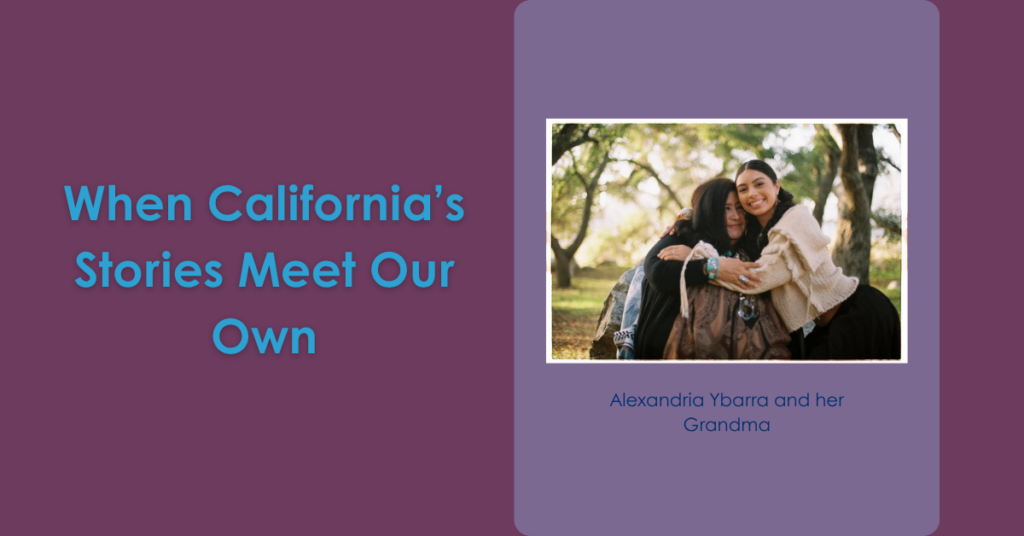
Experiencing American Pachuco: The Legend of Luis Valdez alongside my grandmother—who came of age in the barrio of the San Fernando Valley and whose own journey toward becoming an actor was shaped by the sacrifices of her family, and especially her mother and grandmother, both activist community leaders—felt like I was being transported into another time. Sitting beside her, I found myself seeing the documentary not only through the story of Luis Valdez, but through the experiences of my own family. Especially when historical scenes from the Chicano Moratorium were shown on screen, and my grandmother shared that she was there that day with my Tia, my great-grandmother, and other community leaders. It gave me a deeper understanding of the histories and cultural movements that have, in some way, shaped my own story.
Though the documentary focuses on Valdez’s life, what resonated with me most was how deeply rooted it is in the humanities: the belief that storytelling, art, and community can create space for people to see themselves, understand one another, and not only imagine, but enact social change. Valdez’s work with El Teatro Campesino, created alongside his siblings, colleagues, and later his wife, grew from the California farmworker movement and evolved with the changing times. His theater became a way to bring visibility to communities and experiences that were too often overlooked, while creating opportunities for dialogue, imagination, and civic change.
The story of bringing Soldado Razo—the Chicano experience of a soldier during the Vietnam War and his ultimate confrontation with death—to the stage in Texas, where it was first met with disagreement and eventually connection, stayed with me. To me, that is the power of public humanities work.
Throughout the film, I was in complete awe—deeply moved and inspired by Valdez’s vision, his unwavering belief in himself and his work, and his commitment to a uniquely Chicano style of storytelling. His story reminded me that fulfillment is rooted in connecting to the source within ourselves and to the ancestors, communities, and experiences that came before us. There is power in creating from the place that makes you, you.
California Humanities was the first funder to support American Pachuco: The Legend of Luis Valdez. Supporting projects like this is part of our commitment to bringing forward California stories and perspectives that have too often been overlooked or excluded from the historical record.
For me, experiencing this project with my grandmother made this connection feel especially real. Her memories, my own questions, and Valdez’s story came together across generations. It was a full-circle reminder that California’s history is not one single story, but is made up of countless voices, movements, families, artists, workers, and communities whose experiences continue to shape who we are.
Supporting projects like American Pachuco means supporting the people who are helping us tell that fuller story.